How to write a video hook: seven formulas, and what weakens each
The first line of a short video has one job: to earn the next few seconds. Here is how long it should be, the seven shapes that do the job, the habits that undo it, and a way to score your own before you film.
The RapidCreate team5 min read


In this post 10 sections
Key takeaways
- A hook is the first line and picture of a short video. TikTok’s guidance is to make your point in the first 3 seconds.
- Aim for 4 to 12 words: enough to say what the video is about, short enough to read at a glance.
- Seven formulas do most of the work: a question, a count, “POV:”, a command, a mistake or myth, a contrarian turn, and “how to” or “why”.
- A preamble such as “In this video…” costs more than any formula gains. Start on the hook.
What is a video hook?
A hook is the opening of a short video: the first words a viewer hears or reads, and the picture behind them. Meta describes it as “the text, visual, and audio components that grab and hold attention in the first few seconds of your video” (Meta for Business, The Science of the Hook, December 2025).
Its job is narrow. A hook doesn’t have to explain the video, sell the product or make anyone laugh. It has to earn the next few seconds. Everything after it gets a chance only if the hook does that one thing.
This guide is about the words. The picture matters as much, but the words are where most hooks go wrong, and they’re the part you can fix before you film anything.
How long do you have?
A few seconds, by the platforms’ own account. TikTok’s guidance for advertisers is to “introduce your content proposition in the first 3 seconds” and to “prioritize your hook in the first 6 seconds” (TikTok for Business, Creative best practices for performance ads, updated June 2025).
Three seconds isn’t much. At a natural speaking pace it’s seven or eight words. So a hook that needs two sentences to make sense has already used its time on the first one.
That’s the real constraint, and it’s a useful one. If you can’t say what the video offers in a single short line, the problem usually isn’t the wording. It’s that the video is about too many things.
How long should a hook be?
Between 4 and 12 words. That’s the range RapidCreate’s hook score rates highest: a line you can take in at a glance. From 13 to 16 words a hook is still readable, but it lands more slowly. Past 16 it loses points, because most viewers will have moved on before they reach the end.
Very short hooks have the opposite problem. Two words rarely say what the video is about. “Big news” could open anything.
Which formulas work?
Seven shapes turn up again and again in hooks that hold attention. None of them is a trick. Each one makes a specific promise, and a specific promise is what a viewer stays for.
| Formula | Example |
|---|---|
| Question | What if you’re doing meal prep wrong? |
| Count | 3 mistakes you’re probably making with meal prep |
| POV | POV: you finally figured out meal prep |
| Command | Stop overthinking meal prep |
| Mistake or myth | The mistake with meal prep that costs you the most |
| Contrarian | Nobody tells you this about meal prep |
| How to or why | How to get better at meal prep in 30 seconds |
A question the viewer wants answered. It works when the answer isn’t obvious, and fails when the viewer can reply “no” and scroll.
A count promises a list: three mistakes, five tools, seven signs. The viewer knows how much is coming and stays to see whether they already know it.
“POV:” puts the viewer inside a scene instead of telling them about one.
A command opens with a verb: stop, don’t, never, quit. It’s blunt, and it implies the viewer is doing something wrong right now.
A mistake or a myth invites checking. People stop to find out whether the mistake is theirs.
A contrarian turn says the accepted view is wrong: “nobody tells you”, “the truth about”, “unpopular opinion”. Use it only when you can back it up in the next ten seconds.
“How to” or “why” is the plainest promise of all, and the weakest on its own. It gets stronger with a number or a time attached.
Meta’s own list is shorter but overlaps: a value promise, a statement of intent, and a question or invitation. The names differ. The idea is the same: say what the viewer gets.
What weakens a hook?
Five habits, in rough order of how much they cost.
A preamble. “In this video…”, “Hey guys…”, “So today I want to…”. These are the words people say while they work out what to say. They spend the first second on nothing, and the hook score takes 12 points off for one, more than any formula can win back.
Too many words. Past 16, the viewer has to choose between reading and watching.
Capitals throughout. One capitalised word is emphasis. A whole line of them reads as shouting.
A crowd of emoji. One or two can carry tone. Three or more push the words apart.
Long words. “Utilise your productivity methodology” is slower to read than “Fix your to-do list”, and says less.
There are two cheap wins as well. Speak to the viewer directly (“you”, “your”), and include one concrete figure. “3 emails that got me 40 replies” beats “Emails that get replies” on both counts.
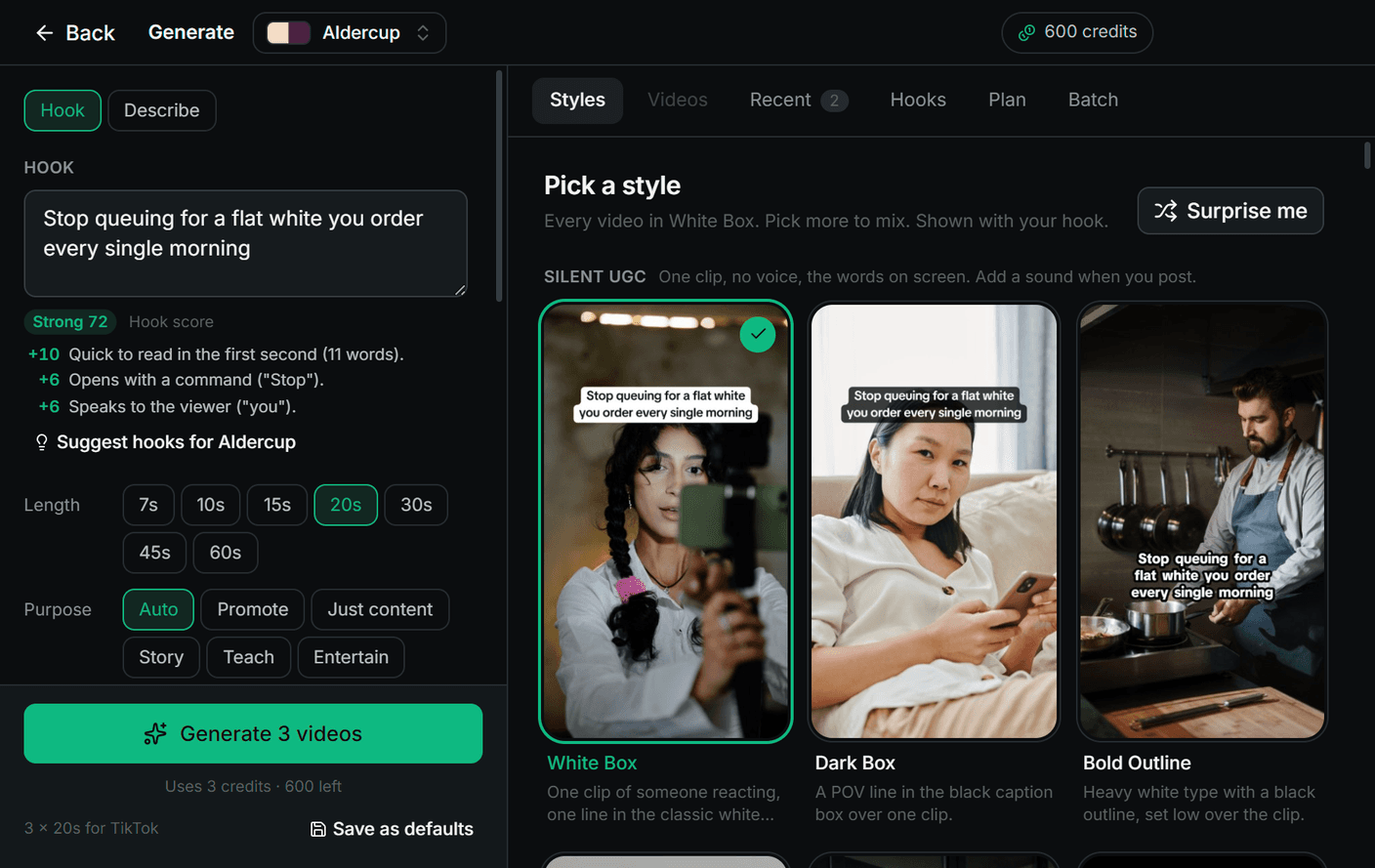
Try it on your own topic
Type a topic and the generator fills each formula with it, then sorts the results by score. Choose one and it moves into the scorer, where you can rewrite it and watch the reasons change. It runs in your browser: no account, and nothing you type is sent anywhere.
Hooks from a topic
Score a hook
Type a hook, or choose one from the list, to see its score and the reasons behind it.
Treat what comes out as a first draft. The formulas give you a shape; what makes a hook yours is the detail only you have. Swap “3 mistakes” for the three you actually made.
How do you know which hook is best?
You don’t, until people see it. A score tells you a hook is readable and well formed. It can’t tell you whether your audience cares about the subject.
So test. Make the same video with two or three different openings and post them a few days apart. Compare how many viewers were still watching a few seconds in; the platforms’ own analytics show it as a retention graph. Keep the shape that wins and write the next batch in it.
Does that mean filming everything three times? No. The opening line and the first shot are all that need to change; the rest of the video can be the same cut.
The hook is a promise
One last rule, and it’s the one that matters most over time. Whatever the hook promises, the video has to deliver, and soon. “3 mistakes” means three mistakes, starting within a few seconds. A hook that overpromises wins the first second and loses the viewer, and the next video, shortly after.
Sources
- Meta for Business, The Science of the Hook: How to Supercharge Your Reels Performance, 15 December 2025, retrieved 12 October 2026: facebook.com/business/news
- TikTok for Business Help Center, Creative best practices for performance ads, updated June 2025, retrieved 12 October 2026: ads.tiktok.com/help/article/creative-best-practices
- The word ranges and point values are RapidCreate’s own hook score, the rules the app applies to every hook typed into it.
Questions
What is a hook in a video?
The opening of the video: the first words a viewer hears or reads and the picture behind them. Its job is to earn the next few seconds, so it should say what the video offers in a single short line.
How many words should a video hook be?
Between 4 and 12 words. That is long enough to say what the video is about and short enough to read at a glance. Beyond 16 words most viewers will have scrolled on before the end.
How many seconds should a hook last?
About three. TikTok’s guidance for advertisers is to introduce what the video offers in the first 3 seconds and to make the hook the priority of the first 6.
What is an example of a good hook?
“3 mistakes you’re probably making with cold emails.” It is eight words, promises a count, speaks to the viewer and names a mistake they may be making. Each of those is a reason to stay.
Free tool: Video Hook Generator
What to read next
Hooks and scripts
How long should a video script be? Word counts for 15 to 90 seconds
How many words fit in a 15, 30, 60 or 90-second video, why speaking pace changes the count, and a free timer to check your own script.
The RapidCreate team5 min read
Carousels and posts
How to make a carousel post: a slide-by-slide structure
What goes on each slide of a carousel, how many slides to make, how much text fits, and how to get the same post onto Instagram, LinkedIn and TikTok.
The RapidCreate team8 min read
Carousels and posts
Instagram carousel size: dimensions, ratios and the 20-slide limit
The size to make Instagram carousel slides (1080 × 1350), the taller 3:4 option, what Instagram’s help pages say about ratios and cropping, and the 20-slide limit.
The RapidCreate team4 min read